01Limits for application
- Air above +10 °C for self-levelling floors and epoxy paints.
- Substrate from +10 to +25 °C for Floor 205 C, from +15 to +25 °C for polyurethane floors.
- Air humidity no more than 80 %.
- Substrate temperature at least 3 °C above the dew point.
02What the dew point means
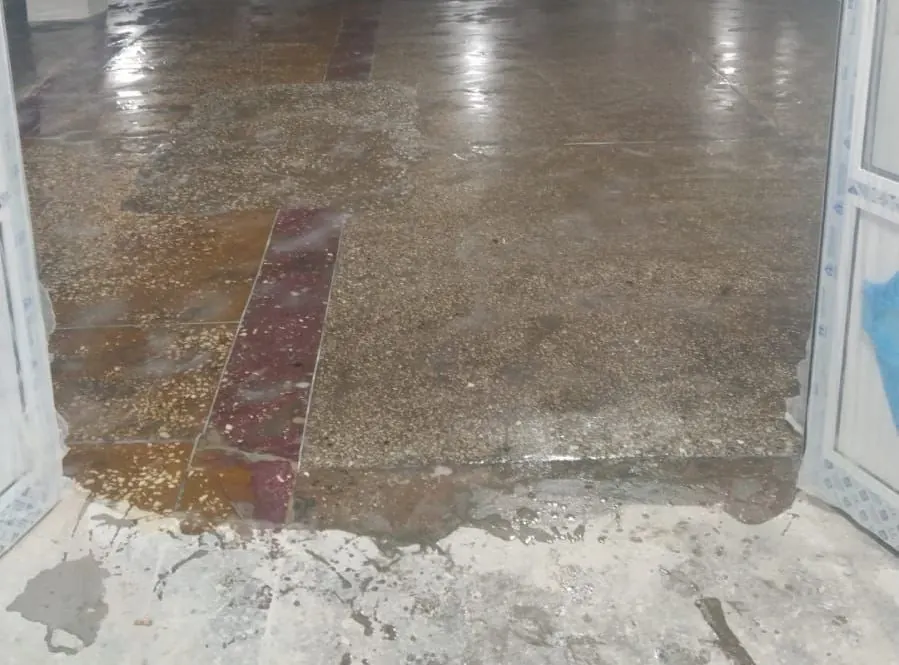
The dew point is the temperature at which water vapour in the air condenses. If the substrate is colder than the dew point plus 3 °C, moisture settles on the fresh coating and spoils its surface and adhesion. Measure the air with a thermo-hygrometer and the substrate with a pyrometer in several places, before and during the work.
| Air temperature | 50 % | 60 % | 70 % | 80 % |
|---|---|---|---|---|
| +10 °C | 0.0 °C | 2.6 °C | 4.8 °C | 6.7 °C |
| +15 °C | 4.7 °C | 7.3 °C | 9.6 °C | 11.6 °C |
| +20 °C | 9.3 °C | 12.0 °C | 14.4 °C | 16.4 °C |
| +25 °C | 13.9 °C | 16.7 °C | 19.1 °C | 21.3 °C |
The table gives the dew point for each air temperature and relative humidity. Add 3 °C to get the lowest allowed substrate temperature: at +20 °C and 70 % the substrate must be at least +17.4 °C.
Dew point check
Enter the air temperature, the relative humidity and the substrate temperature measured with a pyrometer.
- Dew point
- —
- Lowest substrate temperature for work
- —
03Below +15 °C
- The mix thickens and flows worse, so more of it is needed for an even coat.
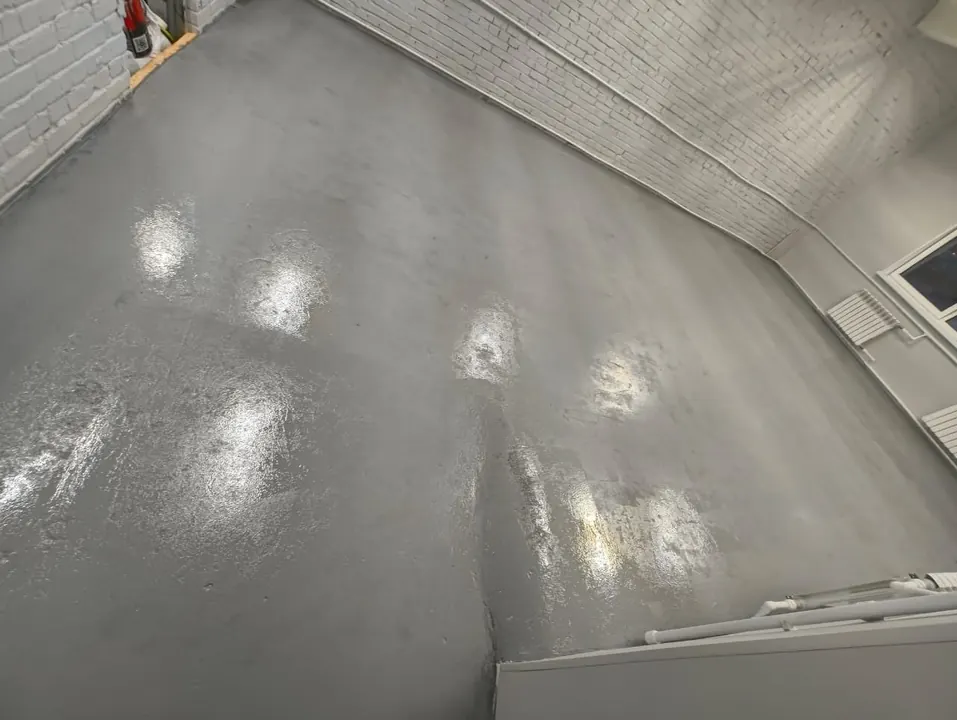
- Air leaves the thick layer slowly: bubbles, craters, lenses and tool marks appear, especially on a cold substrate.
- Curing slows down: every 5 °C below +20 °C adds 20–30 % to the time. At +10 °C an epoxy or polyurethane floor can be walked on after 32–48 hours, and some products do not cure at all until the temperature is restored.
- Epoxy coatings may show a wrinkled pattern similar to crocodile skin.
- The upside: the mix stays workable longer, so there is time to correct defects.
04Above +28 °C
- The mix becomes thinner and flows better; consumption drops slightly.
- After long transport in the heat a dense sediment can form in the bucket: mix component A thoroughly and check the bottom.
- Curing speeds up: an epoxy floor can be walked on after about 24 hours at +20 °C, 18 hours at +30 °C and 8–12 hours at +40 °C.
- The pot life shortens to 10–15 minutes at +30 °C. Mix smaller batches and pour them at once.
- Solvent-borne paints and primers dry too fast and show orange peel.
05Five practical rules
- Keep a thermo-hygrometer on site, preferably a calibrated one.
- Measure the substrate with a pyrometer and check the dew point.
- Never work with cold components: keep the kits for a day at room temperature, or set up a warm corner with heat guns, heaters and a tent.
- Make a test area. If you cannot use the floor, warm a fibre-cement sheet to the floor temperature and practise on it.
- Read the instructions before the work, not after.
06Products for low temperatures
Single-component moisture-curing polyurethanes cure with the moisture in the air and can be applied below +5 °C, indoors and outdoors: Teping PU Primer 1K primer and Teping PU Enamel 1K primer-finish, used in the one-component polyurethane system. Teping R 1155 Primer Fast is applied from +5 °C and can be walked on after 6 hours at +25 °C.
Sources. Based on the instructions and technical data sheets for Teping® products published at tnpgroup.ru and the TNP technical solutions album 2025. Always follow the instruction for the specific product and batch.